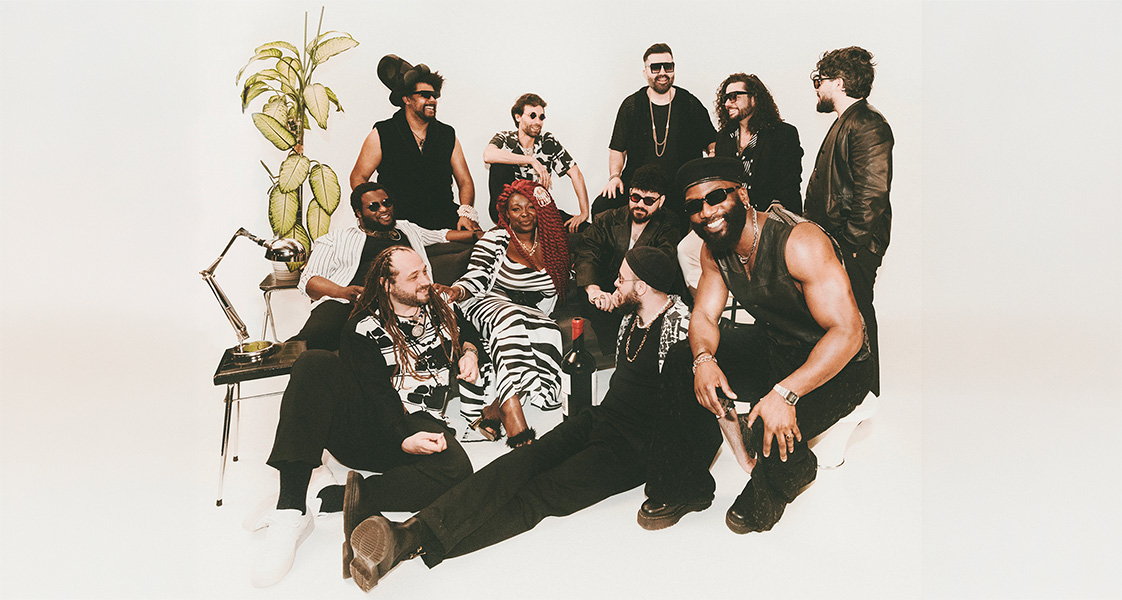
Jéroboam aren’t just another big-band funk outfit – they’re a living, breathing ecosystem of groove. Born from the long-running tribute project Echoes Of, the Paris-based 11-piece has transformed years of studying the greats into a bold, contemporary funk identity of their own. Their debut LP marks a decisive leap: a band stepping out of homage and into authorship, carrying the fire of boogie, the warmth of soul, and the electricity of their cult live shows. This interview dives into the evolution, the community, and the creative chemistry that power one of Europe’s most exciting modern funk collectives.
WWD: You began as Echoes Of, a band deeply rooted in tribute culture and the cities of funk. What parts of that era still live inside Jéroboam today?
We started developing ideas and thinking about beginning an original project a few years back while working as Echoes Of. The more we played this music, the more we felt the urge to be part of it with our own voice. Jéroboam is, in a way, a continuation of that era — the place where we found our sound and our idea of the ideal funk band.
WWD: What did changing your name unlock creatively or psychologically for the band?
Changing our name implied a fresh start and allowed us to develop our original music with a new identity.
WWD: How did the Paris scene shape your early identity, and what gaps did you feel compelled to fill in the European funk landscape?
Firstly, it’s where we all met and became friends — through studies, gigs, and jam sessions. In Paris we met amazing musicians and saw incredible shows in many different styles. We also had the chance to play often at a very important place for us, the New Morning. This venue felt like home and allowed us to shape our sound and perform our music live.
We don’t know if there are any gaps to fill; we’re just happy to share our music in Europe and around the world.
WWD: With 11 members, how do you maintain cohesion, trust, and a shared musical vision?
Through the years, our artistic vision sharpened while playing together, and it was always important for us to develop it collectively. From the beginning, we wanted every part of our music to be both the pillar of the groove and the cherry on top.
WWD: What did you want this debut LP to say about who Jéroboam is right now?
It’s a way of presenting ourselves to the world — putting us on the big stage. An energy-driven band with complementary artists, willing to express as one through funk music.
WWD: The album moves between boogie funk and 2-step soul. What drew you to that crossover, and how did you keep it feeling natural rather than nostalgic?
Honestly, this happened quite organically. Our different influences blend together. We try to be sincere and trust our creative process.
WWD: You’re known as a juggernaut live band. What were the biggest challenges in bottling that energy for a studio LP?
The challenge for us was to create an original sound object that stays true to our live identity. The studio brings many other elements in terms of arrangement, layers, and track construction. We had fun using those.
WWD: What made Favorite Recordings the right home for this first full-length statement?
At our first meeting with Pascal Rioux, owner of Favorite Recordings, it was obvious that we had found the right place. Similar tastes, good vibes. From the early stages of the process, the label’s high standards in musical production and recording quality — and their trust in our creative vision — created the perfect setting for this album.
WWD: You’re often described as one of Europe’s most vital modern funk acts. What does “modern funk” mean to you?
We see it more in a contemporary sense, the music we play in our time.
WWD: Your sound channels the fire and spirit of classic boogie. How do you honour that lineage without becoming a pastiche?
The answer lies in funk and boogie music itself. It encourages you to have your own sound, develop your inner voice, and be your own persona. To quote Cameo: “Be Yourself.”
WWD: What does arranging for such a large ensemble allow you to do that smaller funk outfits can’t?
Limitless discussions. On a more serious note, being an 11-piece band allows us to embody the huge sound of the funk we love. Some legendary musicians and bands found their form with smaller groups, but being 11 is simply what works for us.
WWD: Do your compositions start from a live mindset or a studio mindset?
Honestly, a bit of both. We started composing by playing our freshly made musical parts together, so it’s more live-oriented, but we didn’t hold back on layers of instruments and vocal parts. We tried to have the perks of both worlds — the spontaneity of live performance and the possibilities of the studio.
WWD: Your tribute nights in Paris and London became cult events. What did those nights teach you about audiences, groove, and community?
A lot. Firstly, we felt the support of audiences across countries, and it’s a beyond-words feeling. Live music is a powerful way to connect. Musically, we learned a lot about concert momentum and improvisation, and it gave us plenty to think about.
WWD: You’ve collaborated with Howard Johnson, Junior Giscombe, and Kyoto Jazz Massive. What did each of those experiences imprint on the band?
First of all, we are very grateful for these encounters. It’s crazy to work with these legends, and at the same time it ended up feeling very natural — just making music together. We listened carefully to all the tips, advice, and stories they shared. It gave us a feeling of belonging and strengthened our will to go further.
WWD: Touring and recording with Shuya Okino and Vanessa Freeman is no small milestone. How did that project expand your musical vocabulary?
Over the years we’ve played different styles around funk — jazz-funk, boogie-funk, soul. The special thing with this project was diving into the acid-jazz genre, which reinterprets those styles with touches of house, Afrobeat, Brazilian music. It was an opportunity to put all of these experiences to use in one repertoire — this “crossover music,” as Shuya calls it.
WWD: What’s the moment in a show when you feel the whole room lock in with you?
Often, when everyone in the band lets loose and plays at 110% — during a solo or at the climax of a song. The same thing happens in the audience: everyone lets go, dances, and cheers. It’s really special.
WWD: How have different European audiences shaped your approach to performance?
We approach every show the same way: giving our maximum to deliver the best performance possible. It’s such a privilege to play in different countries for different people, and we hope it’s just the beginning.
WWD: You’ve called 2026 a decisive year. What’s shifting internally for the band?
Nothing is shifting internally, but we hope a lot will shift externally with the album.
WWD: After this debut LP, what’s the next frontier you’re hungry to explore?
A second LP. More seriously, we’re looking forward to touring with our new show and presenting this album. Live shows are what we live for.
WWD: When people look back on this era of European funk, what do you hope Jéroboam represents?
If people keep listening to our music in 20, 30, 40 years, that would already be amazing. Beyond that, we simply hope to be remembered as a joyful live band that makes people dance. Hearing someone in 2057 say, “I saw Jéroboam at the New Morning in 2026 — it was insane. We danced and sang all night long; I wish you’d been there” would be the best thing.
WWD: That it would! Thanks for the chat 🙂
Thanks a lot!
The ‘Jéroboam’ album is available here.