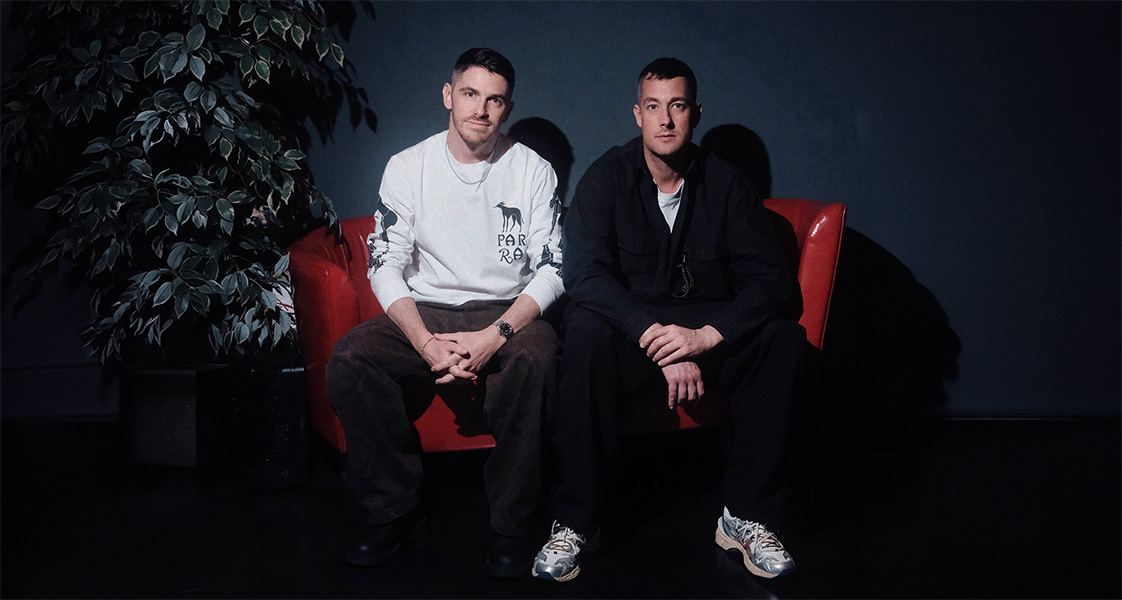

Dirty Channels have spent nearly two decades shaping dancefloors with a sound that’s equal parts heritage, curiosity, and club-tested instinct. From their formative years at Echoes and Take It Easy to collaborations with Chicago royalty, the Milan duo have built a reputation for deep musicality and unshakeable integrity.
Their new EP ‘Jungle Echoes’ distills that journey into a vivid, rhythm-rich story – one that traces the roots of their identity while pushing boldly into new territory. We caught up with discuss all things new EP, blending genres, their new label Eternal Love, production non-negotiables, and more!
WWD: You met in 2007 and quickly became residents at iconic Italian clubs like Echoes and Take It Easy. How did those early residencies shape the DNA of your sound?
Club residencies have always been fundamental to both our career and our musical education. We used to go to Echoes as teenagers, long before we became residents there, and that’s where we really learned what it means to give a club its own musical identity. We learned how to build a dancefloor from the moment the doors open and how to read the key moments of a night.
WWD: After so many years together, how has your creative dynamic evolved? Do you each naturally gravitate toward different roles?
We’ve always shared every aspect of the project, both in the studio and outside of it. Neither of us has ever had a fixed role or a specific specialization. Over the years, though, we’ve naturally started working more independently during the creative process, then coming together to finish the tracks as a team. It allows both of us to express our creativity more freely while still serving the project as a whole.
WWD: What aspects of the Italian scene still influence you today, and what have you consciously moved beyond?
We’re still inspired by the people and the clubs that genuinely put the music first, rather than focusing on image or hype. That’s something we’ll always believe in.
WWD: You describe the EP as a “trip into the jungle of roots” that shaped your DJ careers. What was the spark that set this project in motion?
We’d wanted to bring together all the different musical influences that have shaped us over the years for quite some time. Today it’s not always easy to communicate your musical identity through a single genre, so Jungle Echoes became our way of telling that story and bringing all those influences together in one project.
WWD: The EP merges African rhythms, 80s sequencer energy, and classic Chicago/NYC house. How do you approach blending such geographically and historically different influences without losing coherence?
For us, it happens very naturally because this is the music we’ve always played. Blending these different influences already creates its own identity. The important thing is making those influences your own by living with the records, playing them over and over again, and developing your own perspective. Even the way you mix different genres together is something deeply personal, and that’s where our identity comes through.
WWD: Was there a moment in the studio when you realised: “This is the sound of the record?”
Definitely. From the very first sounds we created, we realised we had found the direction we wanted to follow. Once we heard it, everything else naturally evolved from there.
WWD: You describe ‘Guilty’ as a sunny mixture of South African moods and European 80s/90s vibes. What element came first: the bassline, the piano, or the Kwaito-inspired vocal?
We actually started with the vocal. Everything else – the bassline, the piano, and the overall atmosphere – was built around it.
WWD: The Dub version feels more intimate and basement-ready. What makes a great dub mix in your eyes?
For us, one of the best ways to judge a dub version is whether you can play both the original and the dub in the same DJ set. If they both work while offering two different perspectives on the same track, then you’ve probably done a good job. We always produce our records with the DJ booth in mind, so how they’ll function in a set is a huge part of our creative process.
WWD: This track has a hypnotic, snake-like movement with marimbas and hot synths. What was the narrative or visual world you imagined while producing it?
For Semliki, we took a lot of inspiration from the early 2000s sound of Osunlade and Afefe Iku. That was the music we were playing when we first met, and it also had a huge influence on our earliest productions. In many ways, the track is a tribute to that period of our journey.
WWD: What draws you to African rhythmic traditions, and how do you integrate them respectfully and creatively?
Their history, the fact that African people have always had music “inside them,” and how deeply their music has influenced American music.
WWD: The title track leans into proto-house and 707 rhythms. What does this track represent within the EP’s story?
It plays a key role because it’s the sound that has always defined us. It also has a very important place in our DJ sets. We often use records like this as a bridge between more Afro and disco-oriented tracks and house music.
WWD: You’ve collaborated with Chicago legends like Mike Dunn and Robert Owens. How did those relationships shape your understanding of the Chicago lineage?
They taught us a great deal, but above all they showed us the importance of humility, respect, and love for music. Those are values that many of the great American artists we’ve worked with have passed on to us over the years.
WWD: Are you hardware first, software first, or hybrid? What tools were essential for this EP?
We usually work with a very hybrid and old-school approach, but for this EP we used only analog gear, including the Roland TR-707, the ARP Odyssey, an old Farfisa keyboard, and Yamaha keyboards.
WWD: What sonic markers do you consider “non-negotiable” in a Dirty Channels production?
A great analog drum sound and a bassline that plays a major role in the track.
WWD: Your grooves are always warm, rolling, and human. What’s your approach to rhythm programming and percussion layering?
We always start with a groove that works on the dancefloor. As we’ve said before, the main goal with all our records is to make sure they work well in a club during a DJ set.
WWD: You’ve played everywhere from Hï Ibiza to Djoon to Resolute NYC. How do different dancefloors influence your production ideas?
A lot. The experiences we’ve had in clubs have always helped us improve and approach music production with more maturity. Playing in such important and diverse venues naturally opens your mind and broadens your perspective. Since our productions are so closely connected to our DJ sets, those experiences have really expanded the way we think about making music.
WWD: ‘Guilty’ feels tailor-made for big outdoor moments, while the Dub feels basement-ready. How do you think about scale when producing?
It matters a lot. Sometimes we imagine a track being played in a more intimate club, while others are clearly made for bigger events. That said, one thing that has always defined us is trying to make records that can work in both environments, one way or another.
WWD: After so many years behind the decks, what’s your philosophy on guiding a dancefloor rather than reacting to it?
That’s always been one of our core principles. We always try to earn the crowd’s trust so we can take them wherever we want musically. Over the years we’ve learned how to do that more quickly and effectively, allowing us to shape the rest of the set in the direction we have in mind. Of course, it’s easier in places where people already know us; elsewhere it takes a little more work. But our goal is always to lead the audience while making them connect with what we’re playing. That’s what often makes the difference between one DJ and another. Simply playing great music without people truly understanding or connecting with it has always felt a bit pointless to us.
WWD: What made RNT the right home for this EP?
RNT is a label we’ve always followed and admired. We’ve always appreciated the way they’ve released music across different genres while consistently maintaining a very high level of quality, which is exactly what we wanted to achieve with this EP.
WWD: You’ve worked with Debbie Jacobs, Pastaboys, Don Carlos, Mike Dunn, Robert Owens…what do you look for in a collaborator?
We’re always looking to learn from the people we work with. The artists you mentioned have all been major sources of inspiration for us at different stages of our journey.
WWD: Your new label with Eternal Love is an exciting chapter. What’s the mission behind it?
We started making edits almost for fun, but they immediately generated a lot of attention and excitement. Rush Hour offered to distribute those edits, but we felt it was more appropriate to keep them outside of distribution and instead launch a label focused on original music together with them. Our goal is to build something solid that will last over time by releasing music we genuinely love and that we believe is timeless.
WWD: Your new residency launches with heavyweights like Joe Claussell, Antal, and Danilo Plessow. What do you want this party to stand for?
The one we grew up with: bringing clubs back to being true places of community and culture. Every edition has featured an incredibly high musical standard, but above all a genuine desire to be together on the dancefloor until the very last record.
WWD: After ‘Jungle Echoes,’ what sonic territories are you excited to explore?
We still have to figure that out! Right now we’re just enjoying the release of this EP, and after that we’ll simply follow the flow, just as we always have.
WWD: When people look back on Dirty Channels in 20 years, what do you hope they say?
At this stage of our career, we feel a different kind of responsibility than we did before. We’d really like to set a positive example for younger generations, passing on good values both musically and in terms of attitude behind the decks. We’d like to give back some of what we’ve received throughout our career from the people who taught us, and hopefully one day someone will say, “They were a source of inspiration and taught me something valuable.”
WWD: Wise words! Thanks for the chat 🙂
Thanks a lot!
The ‘Jungle Echoes’ EP is available here.