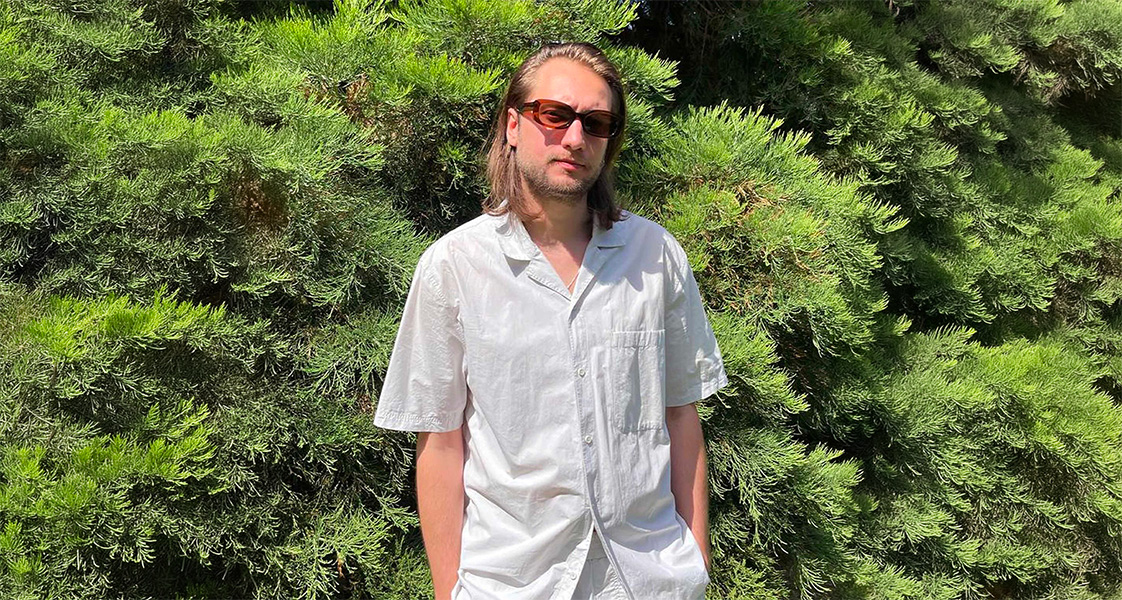
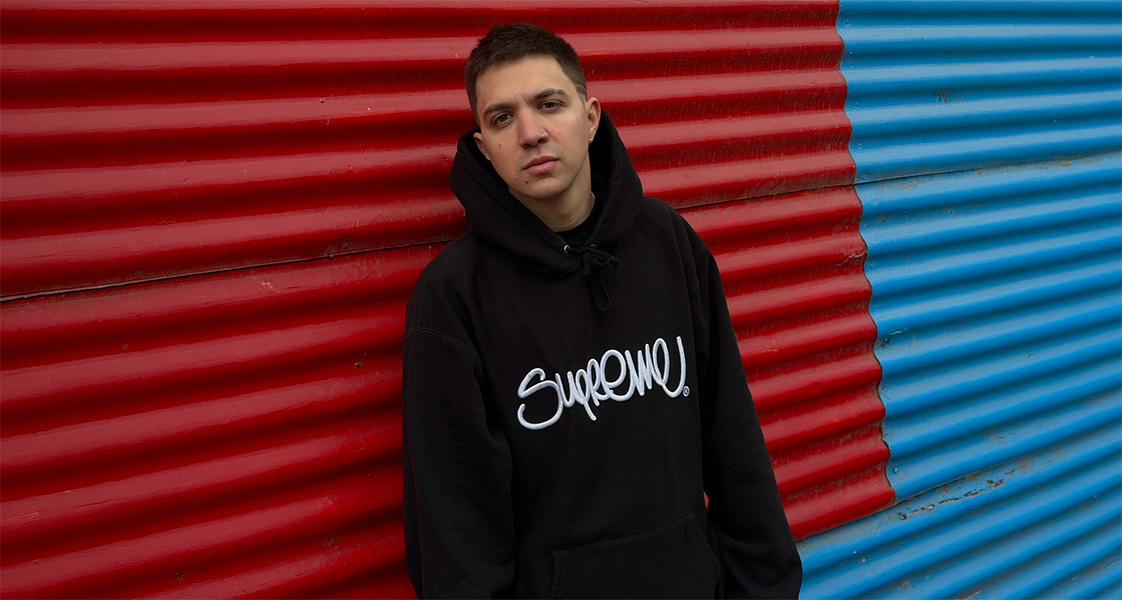
Across his new EP ‘Side Order,’ Paris-based producer Sim Fossil steps back toward the dancefloor with a sound that feels playful, hypnotic and rooted in the late-80s/early-90s lineage he’s always gravitated toward. After the more atmospheric detour of ‘Tidal Figures,’ this release reconnects with the proto-house, Italo and leftfield house influences that have quietly threaded through his work for years.
We caught up with him to discuss blending genres instinctively, the visual cues that shape his titles, the contrasts that give his records depth, and the evolving identity that led him from Cossway to Sim Fossil. He also opens up about his studio process, his relationship with hardware, the emotional movement inside a track, and how Dream Chimney’s community subtly informs the world he builds.
WWD: What sparked the shift toward a sharper, more dancefloor ready focus on this new EP compared to ‘Tidal Figures?’
Normally I’m actually a pretty dance floor-oriented producer. Tidal Figures was more of an exception and quite different from what I usually make. Most of my music sits somewhere around proto-house, Italo and leftfield house, so in a way Side Order is more of a return to where I naturally am.
WWD: How did you approach blending proto house, NuBeat and Balearic techno into a unified three track release?
It usually happens pretty naturally. I wouldn’t say the New Beat influence is super obvious on this release, I’d describe it more as leftfield house and proto-house. But I’m generally very inspired by New Beat, Italo and that whole world, so it’s always somewhere in the back of my head. I never really sit down and decide to make one specific genre. It’s more like everything I’ve been listening to somehow ends up blending together.
WWD: What was the first element that unlocked the title track ‘Side Order’ for you creatively?
I actually tend to come up with titles very late, usually once the music and artwork are already there. I’m a graphic designer as well, so the visual side often helps me understand what the record is supposed to be called. This time I made the cover with these three dancing figures who look like they’re having a very good night and maybe had a bit too much to drink, and Side Order suddenly felt right. It’s slightly silly, casual and not too serious, which also fits the track. And since that track became the centre of the record for me, it made sense to name the whole EP after it.
WWD: What atmosphere or emotional space were you aiming for when building the deeper, heavier world of Elsewhen?
I like building things around contrast, both in design and in music. Contrast gives something more depth. Side Order is lighter, more playful and quite positive, while Elsewhen is much deeper and more hypnotic. There’s also probably more of that New Beat influence coming through there. I wanted that heavier moment on the EP so the whole thing wouldn’t sit in exactly the same emotional space.
WWD: Did ‘Green Hours’ begin as a peak energy track or evolve into that direction during production?
Yeah, that one was supposed to be energetic from the beginning. I wanted one track on the EP to be more direct and straightforward than the others, something with a bit more push, so I pretty much stuck to that idea throughout the production.
WWD: How do your BPM choices shape the mood and movement you want listeners and DJs to feel?
At the moment I make most of my music somewhere around 114–122 BPM. I like that range because it has this slightly slower, retro club feeling. It reminds me of late-80s and early-90s records, where things could still be energetic without necessarily being super fast. That’s probably the era I’m most attracted to aesthetically.
WWD: Which vintage synth textures or eras were most influential while shaping the sound palette of this EP?
I tend to come back to the same families of sounds. A lot of 80s Yamaha and Roland stuff, FM synthesis, classic digital and analogue synth textures. Usually it’s a mixture rather than trying to recreate one particular machine or period exactly.
WWD: What draws you to the intersection of house, Italo, Balearic and leftfield club music rather than a single genre lane?
I’ve been making music under different aliases for around 15 years, so naturally I’ve gone through quite a few phases. I used to make deep house and minimal, but I’ve also always listened to loads of completely different music. I never really stayed inside one genre as a listener, so it would feel strange to do that as a producer. Eventually all of those influences just started overlapping.
WWD: What motivated your shift from producing as Cossway to the more introspective and cinematic identity of Sim Fossil?
I felt like Cossway was slowly taking me somewhere that didn’t really represent me anymore. I grew out of deep house and spent a few years trying to figure out what I actually wanted my music to sound like. Cossway became a little limiting in that sense. I still like some of those records, though, and I’m sure that whole minimal/deep sound will come back again at some point. Music and fashion move in cycles, just with each generation adding something new to it.
WWD: How has your decade in the electronic scene influenced your current approach in the studio and behind the decks?
A lot, I think. I still remember making tracks in Fruity Loops as a teenager, and all those years of trying things, making mistakes and picking up little tricks eventually become part of how you work. Electronic music can sound deceptively simple, but there’s an enormous amount of technical and musical knowledge behind making something genuinely good. I’m still learning all the time. I actually really enjoy the technical side, especially mixing and sound engineering.
WWD: What does movement mean to you in a musical or atmospheric sense?
For me movement in music isn’t necessarily just about making people dance. Obviously rhythm and physical movement are important, but I’m much more of a producer than a DJ. DJing is something I enjoy from time to time, but I’m probably more interested in how a track moves internally, how it develops, shifts and creates a feeling of motion. I love dancing, but I definitely love music more.
WWD: How do you balance nostalgia and forward facing ideas without leaning too heavily in either direction?
I don’t really think about it as balancing nostalgia against something futuristic. I just use sounds and references that genuinely excite me. A lot of those references happen to come from the late 80s and early 90s, but I’m making the music now, with current tools and everything I’ve absorbed since then. So hopefully it naturally becomes something slightly different rather than pure imitation.
WWD: What does a typical studio session look like for you in terms of workflow and creative process?
Basically creative torture 🙂 I spend way too long perfecting a loop without actually finishing the track. I make tons of sketches, listen to them until I hate them, abandon most of them, and then when I finally manage to finish something I usually hate that too. Somewhere inside all of that I’m just trying to trust my gut while also judging things as objectively as possible, which is obviously not very easy.
WWD: How important is hardware in achieving the analog textures and atmospheres present in your work?
To be completely honest, hardware isn’t essential for me. I experiment with it and I love analogue synths, but working digitally is often much easier, and nowadays if something is mixed well I don’t think most people could tell the difference anyway. I care more about actually building the sound rather than whether it came from hardware or software. I use Pigments a lot at the moment because you can basically build anything inside it. If I want something dirtier or less controlled, then I’ll usually mix that with analogue synths or other older instruments.
WWD: Do your tracks usually begin with rhythm, melody, texture or a conceptual idea?
It almost always starts with a loop. I’ll build a few melodic or rhythmic ideas with a groove, and then the track grows out of that. One thing I’ve been doing recently is starting from a template where the drums, bass and basic structure already run for six or seven minutes. Then I start cutting it apart, removing things, introducing modulation and building the arrangement. It helps me avoid getting trapped in an amazing 16-bar loop that never becomes a track.
WWD: What resonates with you about Dream Chimney’s identity and longstanding community driven history?
I really like the laid-back feeling around Dream Chimney. It feels open-minded and not overly concerned with fitting into one very specific box. There’s also genuinely a community feeling around it, which I think is pretty rare and something I really appreciate.
WWD: How does releasing on Dream Chimney influence your creative direction, if at all?
It doesn’t dictate what I make, but it’s definitely somewhere in the back of my head. With every label I work with, I’m aware of the community, the general taste and the atmosphere around it. For Dream Chimney I probably wouldn’t send something super dark or aggressively main-room. I naturally think of something a little lighter, more detailed, maybe slightly stranger, and something that also works outside of a club.
WWD: What felt different about creating ‘Side Order’ compared to your debut EP for the label?
The obvious difference is that the music itself is quite different from the first EP. But I also know Dream Chimney better now, so I probably feel more comfortable just sending them things and seeing what resonates. There wasn’t one huge change in the process, it just felt a bit more natural this time.
WWD: How does living and creating in Paris influence your sound or perspective as a producer?
I’ve always been quite drawn to house music, but I also listen to a lot of jazz, easy listening and classical music, especially while I’m working on design. Paris probably reinforces that lighter side of my taste. There’s something elegant, slightly relaxed and optimistic about the city that makes sense with the music I want to make. I’ve never really associated my own music with something very dark or purely techno.
WWD: What part of your sound are you most excited to explore next?
Good question, I don’t really know yet ! Usually I make one track that excites me and then the next few tracks grow out of that world. Right now I feel myself leaning towards house again, probably with more early-90s influence. Maybe even a little progressive house, which I’m finding really interesting again. I might also go slightly faster with the BPM for a change. But there’s no master plan really. The main plan is just to make more music.
WWD: What do you hope listeners feel when they hear ‘Side Order’ for the first time?
Hopefully they want to hear the rest of the record, and then maybe dig a little further into my other music and mixes 🙂 That’s probably the best reaction I could ask for.
WWD: It is! Thanks for the chat 🙂
Thanks a lot!
The ‘Side Order’ EP is available here.