


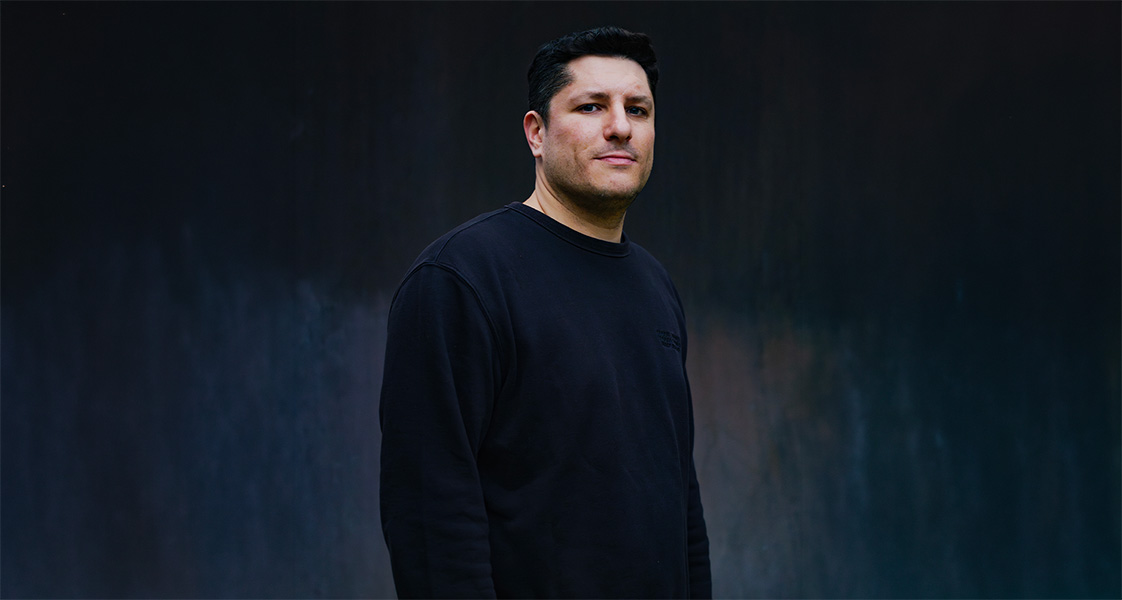
There is a certain kind of artist shaped not by spotlight but by rooms, records, and the quiet graft behind the counter. Across Leeds in the early 2000s, through long nights, long shifts, and longer record hunts, Ste Roberts found the foundations of a sound that still mutates two decades on.
His story moves through Tribe Records, Hypercolour, Glass Table, Rinse FM, and a maze of machines that never behave, always surprise, and constantly pull him into new territory. What follows is a conversation with an artist who has stayed true to the underground, true to instinct, and true to the idea that music should move both the floor and the listener.
WWD: What feels most foundational to the artist you became when you look back at Leeds club culture and your time with Tribe Records?
If I did not move to Leeds when I was 18, I doubt I would be who I am today. I moved to Leeds in 2003 when the city’s underground scene was popping. Every weekend there were multiple nights to go raving. It was a really special era in Leeds. My time at Tribe was an incredibly happy time in my life. I have always been obsessed with records, so to be the man behind the counter and having first picks of all the amazing records definitely helped shape me. Simon Scott who still runs the shop today is a true unsung hero of our scene, and I was very fortunate to spend many years working with him.
WWD: What were the genuine turning points across Hypercolour, Glass Table, Rinse FM, and the various labels that shifted your sound or mindset?
My days with Hypercolour and Glass Table did not necessarily influence my sound, there were three of us with relatively different tastes, however it did help set me up for what I am doing now for sure. Rinse was a lovely platform for me to regularly record mixes from all the music I was buying, however after a decade on the airwaves it was time to dedicate that time elsewhere, and it allowed me to spend some time on a live show.
WWD: You have often operated in the shadows of the scene. Is that a conscious choice or simply where your creative instincts lead you?
In the shadows to me is underground. This is where I belong in the scene. I do not set out for stardom, I just do what I love, and whoever appreciates this, great.
WWD: How do you approach the balance between dancefloor functionality and experimentation in your productions?
I do not, I just make what I want to make. Any of my productions will start with what mood I am in on that day; this may change on another day. One day I may want to make an electro track, the other a tech roller. I have over two decades of inspiration, so I just go with my flow. I love the idea of moving a dance floor, I also have the same love for simply just moving the listener.
WWD: What draws you to machines that misbehave, malfunction or drift into instability?
I just love hardware kit. I am obsessed. I seem to go down many rabbit holes to find obscure sounding machines as opposed to the obvious classics. Then the learning process happens, and I just record all the noodles. This most definitely adds to all of the above.
WWD: When you start a track, what usually comes first for you: rhythm, texture, a concept, or an accident worth chasing?
As mentioned above, it is the mood I am in that directs me. No track starts the same as the last. I guess after 30 minutes or so the concept is underway.
WWD: What was the initial spark behind the Cyphon Recordings EP?
I received a lovely email from Jamie asking me for a demo. I sent some bits, and at the time my more twitchy, wonky sound was not quite what the label were after. We sparked the conversation again a year or so later, and the tracks I had finished were more in line with where the label was heading. Ey Aye EP was born.
WWD: What were you trying to capture or distort in ‘There is a Schizophrenic In Our Park?’
This track has the best story of all my tracks. One evening I was heading into town for a friend’s wedding celebration and I was on the train when a man came and sat next to me and started to tell me his life story and he mentioned he was a homeless schizophrenic living in Ally Pally park. His story was an eye opener, so I handed him ten pounds for a shelter that night. Randomly I saw him the next day drinking on the underground after he told me he was teetotal.
Anyway, I was writing a track at the time, so I decided to search for some spoken clips from a schizophrenic to use in the track, and I found a great one with a guy talking about how he was in a loop where he was talking to a friend at a wine bar in the garden of Eden. I took that moment and recreated the vocal through a vocoder I have, and the track developed from there.
WWD: How different is your mindset when recording live versions like ‘Queen Bee’ compared to studio pieces?
Queen Bee was a track that I produced many years ago, and it was a real turning point for me and my productions. Fast forward to me putting together a live show and it had to feature, however I was not happy with the drums. For the live show I created new drums and it was a full rebirth of the track for me, so as a first and one off we have a reborn version of one of my tracks.
WWD: What does Detroit futurism represent to you, and how does it feed into a track like ‘Ey Aye?’
It is funny as I never thought ‘Ey Aye’ was Detroit-sounding, and maybe more European minimal with a UK twist. I guess this is the beauty of music, one can hear a different inspiration than another. I am happy this track is on the EP. It is more driving and maybe more twisted than the others.
WWD: Why did you choose to end the EP with something more reflective and melodic like ‘Lemon Top?’
This was an older unreleased track I had, however it did need a rework. I was going to release this on my own label at some point as its deeper edge is another side of my productions that I love to showcase. It feels like a perfect B2 so I am over the moon that the Cyphon team agreed.
WWD: How do you decide which ideas belong on which label or project across such a varied catalogue?
This can sometimes be my choice or others. If it is for one of my labels then of course I sit on things for a few months until I believe the work is an EP. If another label requests a demo I will send what I believe would fit the label. I will send as many cuts as I can so the label can decide what will fit or not.
WWD: What role do your Private Parts and STEDIT labels play in your creative freedom?
A lot. Private Parts is a platform for me to express my taste from other artists along with myself. I set this up in 2022 with a reissue from 1995 and the label has developed from there. I am lucky enough to have a family of incredible artists now and I do not regret a single release. I have some fun things in the pipeline and I am very excited. STEDIT is a fun label where I take tracks and rework them my way.
WWD: What do you think the UK scene is getting right at the moment, and where do you feel the cracks?
I feel the UK scene is in a good place right now. The underground seems to be healthy, UK festivals such as Houghton and Gottwood are growing in reputation whilst maintaining their identity and direction. Small clubs such as Cobalt Studios in Newcastle exist and there are a lot more of these smaller clubs around the UK pushing the underground scene. It is worth concentrating on the positives as opposed to the negatives.
WWD: What keeps you pushing into uncomfortable or unpredictable sonic territory?
I do what I do through love, passion and dedication. Without this I would not be doing it for the right reasons.
WWD: Do you think of your tracks as narratives, experiments or functional tools for DJs?
I want DJs to enjoy my music. If they find use for it in their sets, great. If they do not then no offence taken, there are a lot of other amazing artists out there doing great things.
WWD: How do you know when a track is finished, especially when its identity comes from instability?
I guess it is just a feeling. Sometimes I think a track is finished, however months or even years later you listen back and it is not quite. Lemon Top is a prime example of this. Other times a track just hits, and when you know, you know.
WWD: What sonic territory are you interested in exploring next?
I do not even know that yet. Stay tuned.
WWD: We will! Thanks for the chat 🙂
Thank You!
The ‘Ey Aye’ EP is available here.