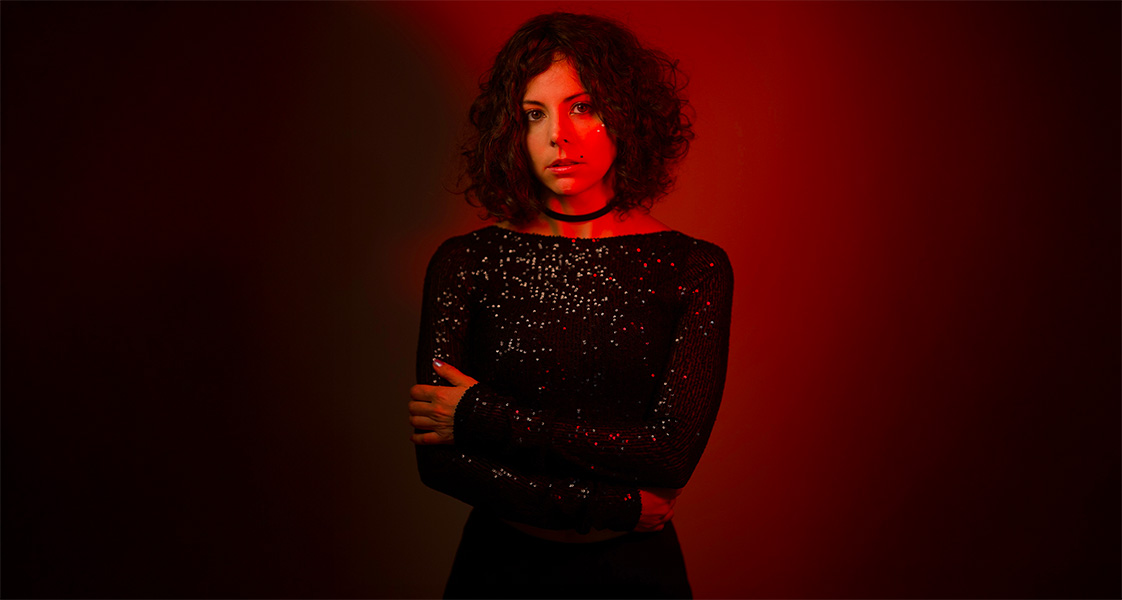
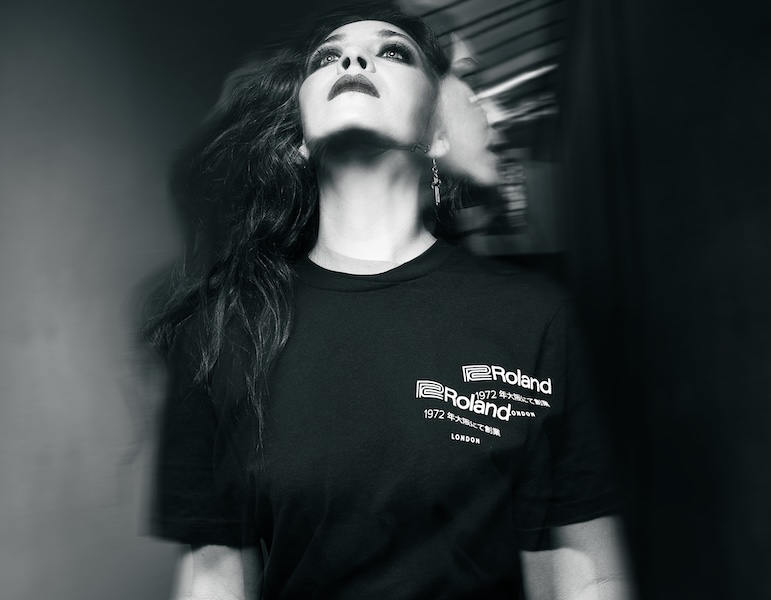
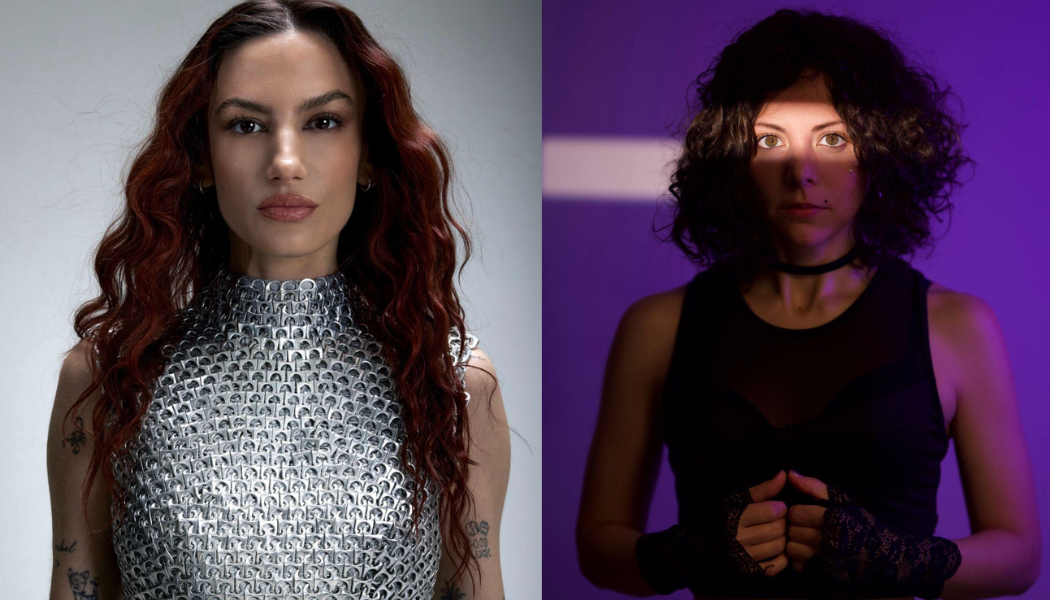
Giorgia Angiuli is an Italian live artist, electronic producer and classically-trained musician who, as she emerges into a new chapter of her artistry, is embracing her most authentic self yet. Loved by peers, fans and tastemakers for her live sets, original releases and label ‘United’ – home to her late-2021 second studio album ‘Quantum Love’, acclaimed by Vogue Italia and beyond – 2024 welcomes releases on labels including Armada Music, Sony, Artcore and Filth on Acid (TBA).
The latter two labels demonstrate her recent shift in musical style. Now best described as a hybridity of psy techno and trance, although as colourful and playful as ever whilst exploring artistic and scientific topics – healing and spirituality – we are witnessing a harder and faster, yet still beautifully poetic side of Angiuli. Both, in Giorgia’s eyes, are forms of healing with the topic resonant throughout her life in recent months. Following several impactful trips to India, and an exploration into the connection between music production and self awareness of late, this psy-influenced sound embodies a period of self-work and a sense of therapy in equal measure. As she says:
“Dance music events can have a significant positive impact on our wellbeing. They can trigger the release of mood-enhancing neurotransmitters, help reduce stress levels, and even boost our immune system. Dancing and sharing times with other people integrate brain areas to improve neuroplasticity. It’s fascinating to observe how music can stimulate both the central nervous system and the peripheral nervous system. The central nervous system, which includes the brain and spinal cord, processes the music, while the peripheral nervous system, which connects the central nervous system to the rest of the body, helps translate these auditory experiences into physical responses. This holistic activation contributes to the overall positive effects on our health and well-being.”
Whilst Angiuli’s sonic identity has shifted, her live setup remains the same, with her vocals still carefully intertwined throughout. She combines synths, drums, theremin,
modified kids’ toys and multiple Bluetooth midi controllers. She collaborates with several brands, always happy to test new gear. Mixing samples and loops, she shapes a vibrating, energetic groove that ignites the dancefloor, which rendered a feature in DJ Mag’s ‘How I Play Live’ video series from OFFSónar. She also collaborates with the brand Aodyo, producing a musical instrument ‘Sylphyo’ – Giorgia Angiuli’s edition.
On the events front, and thanks to her cutting-edge music style (plus early viral videos), she has played the most pivotal international festivals, clubs and beyond. In 2024, this most notably includes Sunburn (India), Ultra Music Festival (Miami), Awakenings (Netherlands) Elrow Town (Italy) and radio show A State of Trance. Across the years, she has also been welcomed by Warung (Brazil), Loveland (ADE), Dockyard Festival (ADE), Sandbox Festival (Egypt), Plages Electroniques Festival (France), Paradise Amnesia (Ibiza), Stereo (Montreal), Fusion Festival (Germany), Cityfox (USA), CRSSD (USA), Exit (Serbia), Baum Park (Medellin) and several more.
Angiuli’s previous releases – whether singles, remixes or longer form – are of equally strong, and extensive, calibre. 2023 saw her add labels Purified, Mobilee and Armada to her back catalogue, with 2022 also bringing several releases on Armada in addition to a debut on Spinnin Records. Elsewhere, her inclusive label United launched in 2020 in response to the pandemic, home to her sophomore album ‘Quantum Love’ (2021). As with her debut LP, ‘In A Pink Bubble’ (2018), she unsurprisingly gained a plethora of global press attention from seminal tastemakers including the aforementioned Vogue Italia plus DJ Mag UK / Italy / Spain / Brazil, TRAX (France) and Attack Magazine (UK).
Giorgia Angiuli opens a new chapter with her forthcoming single ‘We Rave We Heal’, the debut on her new imprint We Heal, set for release on 6th March. The track marks a new direction and focus for 2026 for the Italian live artist, placing sound healing and emotional well-being into club culture to create music designed to scientifically move both body and mind.
We had a chat with her to discuss her new vision and the new label. Have a great read!
WWD: We Heal is presented as more than a label, but as a platform where science, emotion and club culture meet. What personal moment or realisation made you feel it was the right time to create a project like We Heal, and how does it differ from the way you approached your music before?
Since I realized that healing is a big part of my life, everything changed for me. I started studying many books about these topics, and over time, it became something deeply integrated into my daily life and my vision.
My dream with ‘We Heal’ is to create a community where we can share these values together. I truly believe that music plays a key role in the healing process. When we dance, we release negative energy, emotions, and sometimes even deep trauma. The dancefloor becomes a space where people can reconnect with themselves and with others.
With ‘We Heal’, I wanted to bring science, emotion, and club culture together, not just as a label, but as a platform where music can be a tool for transformation and collective healing.
WWD: You speak openly about studying sound healing and working with frequencies, instruments and techniques to support balance in the body. How did this research concretely influence the production of ‘We Rave We Heal’, from sound design choices to structure and arrangement?
‘We Rave We Heal’ is more like a manifesto. The concept is about the idea that the rave can be a space for release and transformation.
Musically, the track is techno with strong acid lines, melodic elements, but still very groovy and fast — around 145 BPM. The energy is important because the movement of the body through rhythm is already part of the healing process on the dancefloor.
For this track, I didn’t use any specific sound-healing frequencies. Instead, the influence comes more from my personal journey and the way my vision of music is evolving.
I’m currently refreshing my sound and exploring new directions.
During this path, I’ve developed a deep love for the 303. I use it a lot in my productions, and sometimes even during sound healing sessions, because the patterns it creates can be very hypnotic and repetitive, almost like a mantra. That repetitive movement of sound can guide people into a more meditative or trance-like state, which connects in an interesting way with the idea of healing through rhythm.
WWD: In the track, the acid 303 lines are described as having a direct effect on the nervous system and emotional release.How do you approach designing and tuning these more “aggressive” rave elements so that they remain aligned with a healing and conscious intention?
The acid 303 can sound aggressive, but for me that intensity has a purpose. When I use it in that way, it’s meant to activate energy in the body and stimulate the nervous system. On the dancefloor, strong and raw sounds can help people access emotions that are often repressed in daily life.
I believe it’s very important to release emotions like anger and resentment. Many people carry these energies inside for a long time, and the rave can become a safe space where they can finally express and transform them. The intensity of acid techno can bring these emotions to the surface and release them through movement and dancing.
At the same time, the 303 is a very versatile instrument. If I close the cutoff more and soften the sound, it becomes much warmer and smoother. In that case it can guide the listener into a more meditative state, but still an active meditation — something that happens through rhythm and repetition rather than silence.
So depending on how it’s shaped, the same instrument can either create a strong cathartic release or lead people into a hypnotic and introspective state. For me, both directions are connected to the idea of healing through music.
WWD: You mention that the ideal tempo range for this project sits between 138 and 145 BPM — fast enough for the body, but spacious enough for the mind. How do you personally experience this balance between physical intensity and meditative or trance-like states when you perform this music live?
I think we live in a culture of overthinking, where people spend too much time in their minds. Because of that, reconnecting with the body has become extremely important. This is one of the reasons why I felt the urge to start playing faster.
When the tempo is higher, the body naturally responds. People start moving more instinctively, and this helps them come out of their heads and back into a physical experience. On many dancefloors today you still see people disconnected from their bodies, often spending a lot of time on their phones or screens, even during a party.
For me, the range between 138 and 145 BPM works really well because it creates a strong physical drive without losing space in the music. The rhythm pushes the body, but the grooves, melodies, and hypnotic patterns can still guide the mind into a trance-like or meditative state.
When that balance happens during a set, something special emerges: people stop thinking so much and simply move. In that moment the dancefloor becomes a space where the body leads and the mind can finally relax.
WWD: You have shared that your own journey through anxiety plays an important role in the philosophy behind We Heal. How do you hope people on the dancefloor will emotionally connect with We Rave We Heal, and what kind of collective experience are you ultimately trying to create through this new label?
My personal journey with anxiety has definitely influenced the philosophy behind We Heal. Going through that experience pushed me to explore many different practices and studies about healing, the body, and the mind. Through that process I understood how powerful music and collective experiences can be in helping us release tension and reconnect with ourselves.
With ‘We Rave We Heal’, I hope people on the dancefloor can feel that sense of release. Sometimes we carry stress, anxiety, or emotions that we don’t express in daily life. When we dance together in a space with strong energy, rhythm, and connection, something shifts. The body moves, the mind slows down, and people can let go of what they have been holding inside.
Ultimately, the vision behind the label is to create a collective experience where the dancefloor becomes more than just entertainment. It becomes a place where people can reconnect with their bodies, express their emotions freely, and feel part of a community. In that sense, the rave becomes a shared ritual where music, movement, and human connection come together as a form of healing